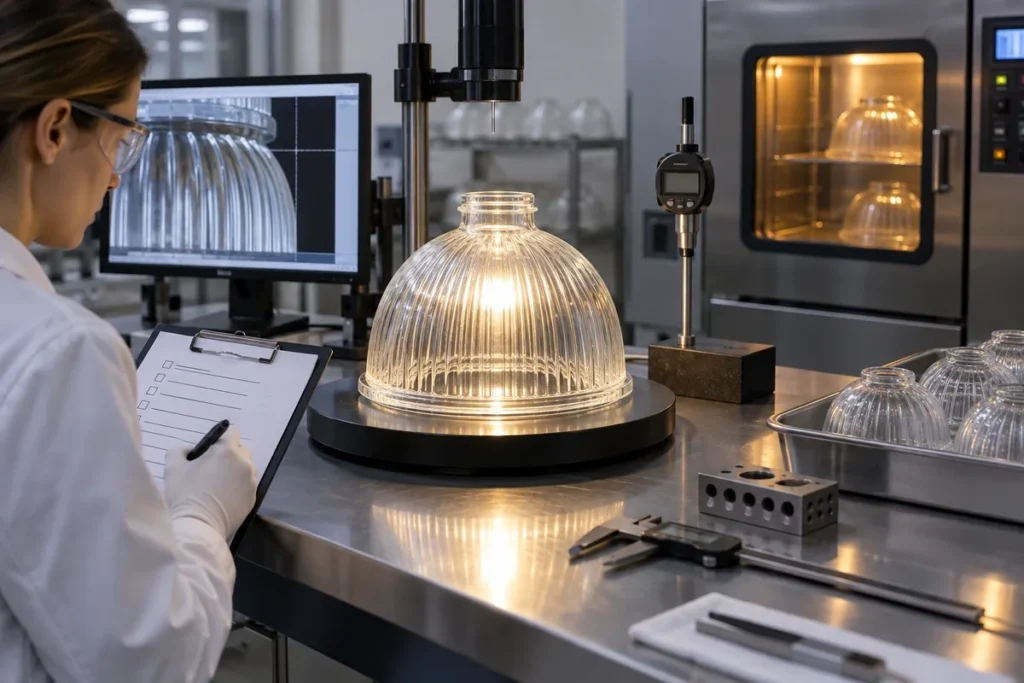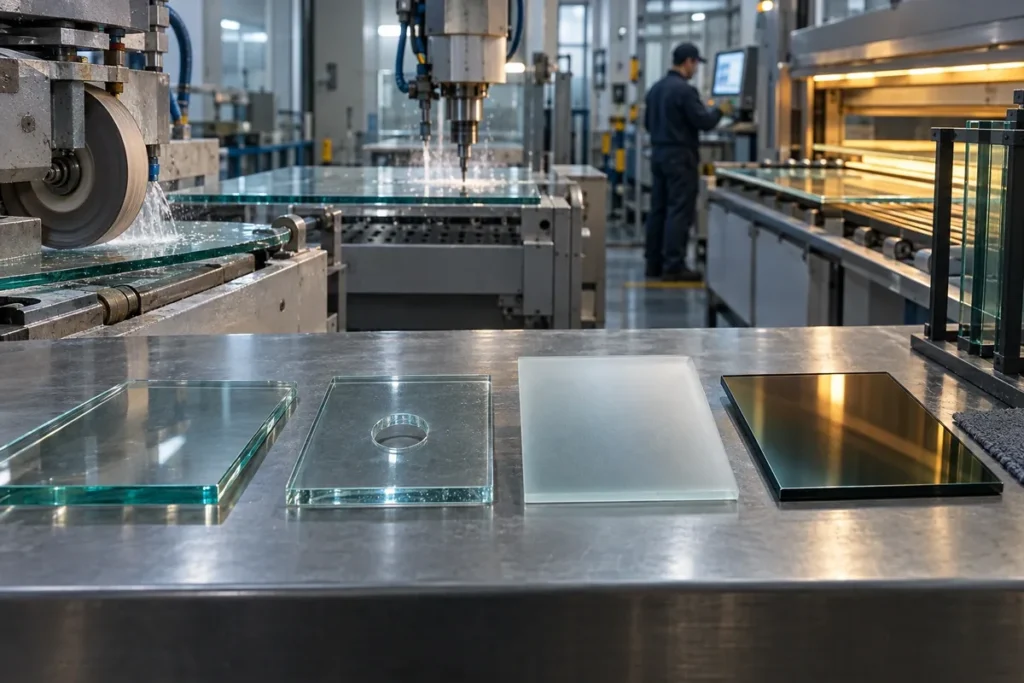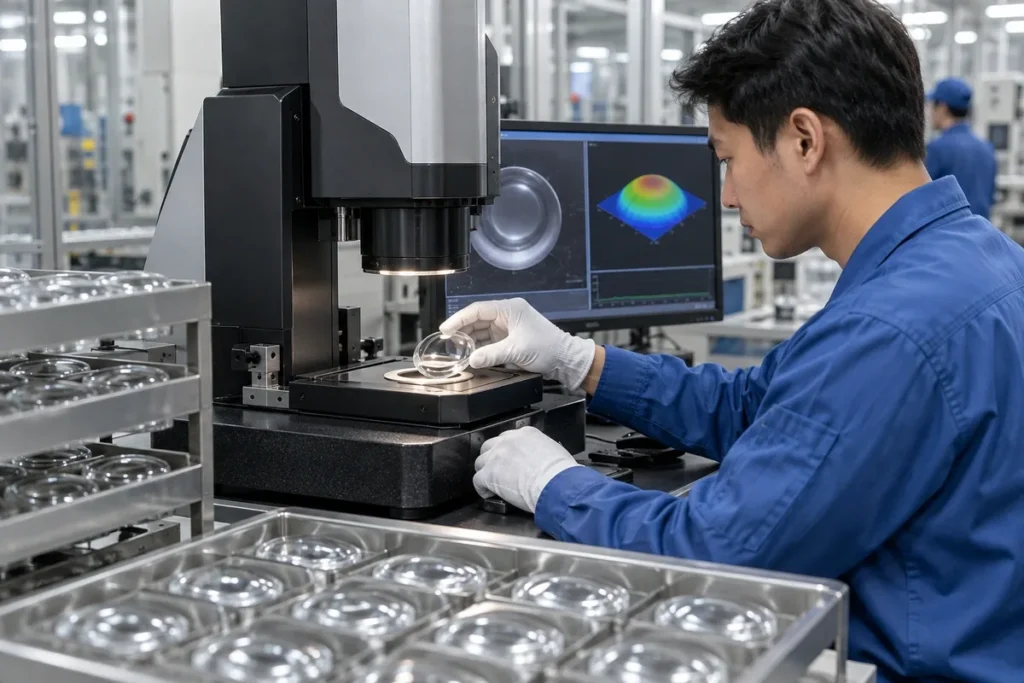
Freeform glass lenses use surfaces without rotational symmetry to send different regions of a source toward different parts of a target. They are useful for street lighting, wall washing, architectural accents and equipment illumination where a circular beam wastes light or creates glare. A successful freeform project begins with a coordinate system, source model and intensity target, then carries those definitions through mechanical alignment, mold manufacture and functional testing.
Key Takeaways
- Define the target intensity distribution, orientation and working geometry before designing the surface.
- Use the real extended source and include package, spectrum and temperature effects.
- Add mechanical keys so the non-symmetric lens cannot be rotated or reversed in assembly.
- Validate with photometric data and surface measurements referenced to the same datums.
How Does a Freeform Lens Create an Asymmetric Beam?
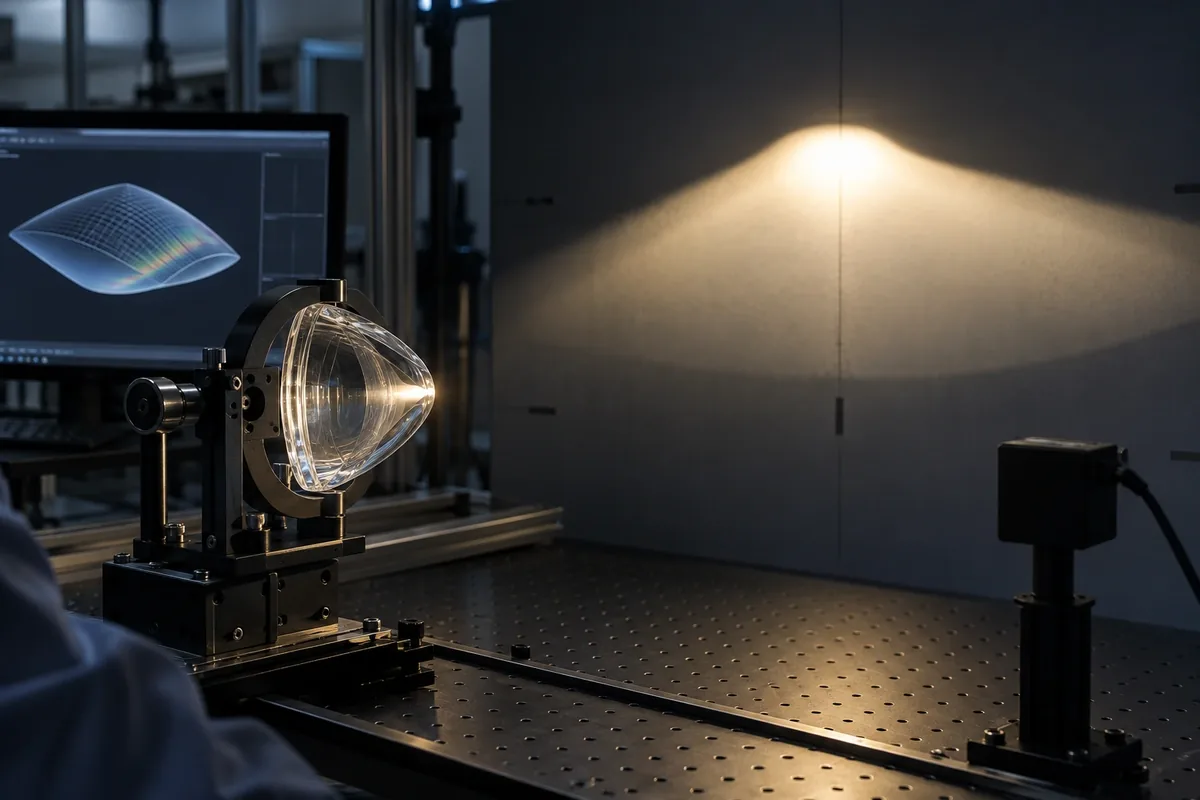
A conventional rotational lens treats every azimuth similarly. A freeform surface changes local slope in both axes, allowing rays to be redistributed into a rectangle, roadway pattern, wall strip or offset field. The surface may use refraction, total internal reflection or a hybrid architecture.
Each region of the optic contributes to the target. Small form errors or source shifts can move energy between zones. For that reason, the design file, lens orientation and assembly datums must be controlled as a single system.
Inputs for a Freeform Lighting Design
| Input | What to define | Risk if missing |
|---|---|---|
| Source | LED part, ray file, emitting area, spectrum and flux | Designed beam will not match production source |
| Target | Plane/road coordinates, intensity grid, cutoff and uniformity | No objective optimization or approval basis |
| Geometry | Source-to-lens and lens-to-target positions | Incorrect magnification and distribution |
| Envelope | Maximum size, holder, thermal clearance and parting constraints | Optical design cannot be assembled or molded |
| Tolerances | Centering, tilt, rotation, surface form and index | Nominal performance is not repeatable |
Design Mechanical Orientation into the Part
Because the output is directional, a freeform lens needs an unmistakable orientation feature. Flats, tabs, asymmetric holes or keyed holders can control rotation. The mounting datum should relate directly to the optical surface coordinate system. Avoid relying only on a visual mark that can be missed or removed.
Thermal expansion and assembly clearance should not allow the lens to rotate in service. At the same time, the holder must not clamp the glass into high stress. Use distributed contact and positive location.
Connect Optical Surface, Mold and Photometry
The freeform prescription may be delivered as a CAD surface, point cloud, polynomial or sag grid. Agree which file is authoritative and how it will be transformed into tool coordinates. Mold smoothing that seems visually harmless can change the target distribution, so any deviation needs optical review.
Inspect critical form relative to mounting datums, then measure the beam with the intended LED and orientation. Use consistent distance, detector geometry and normalization. Store a reference intensity map for future lot comparison.
Custom Freeform Lens Development
China Lampoptics reviews freeform glass lens projects for molded geometry, tooling, material and functional inspection. A complete optical prescription is preferred, but a target distribution and source model can also support early feasibility discussion.
Provide the LED ray data, target photometry, installation orientation, mechanical envelope, temperature, material and volume. The review will identify optical or manufacturing inputs that remain open before tooling.
Watch: A Related Glass or Optics Process
This Edmund Optics demonstration visualizes basic ray redirection. Freeform optics extend the idea by controlling local surface slope differently across two dimensions.
Related Products and Capabilities
Continue Reading
Discuss Your Freeform Glass Lenses Project
Send your drawing, application conditions, quantity and the characteristics that matter most. China Lampoptics will review the information and identify the open technical items before quotation.
Contact China Lampoptics