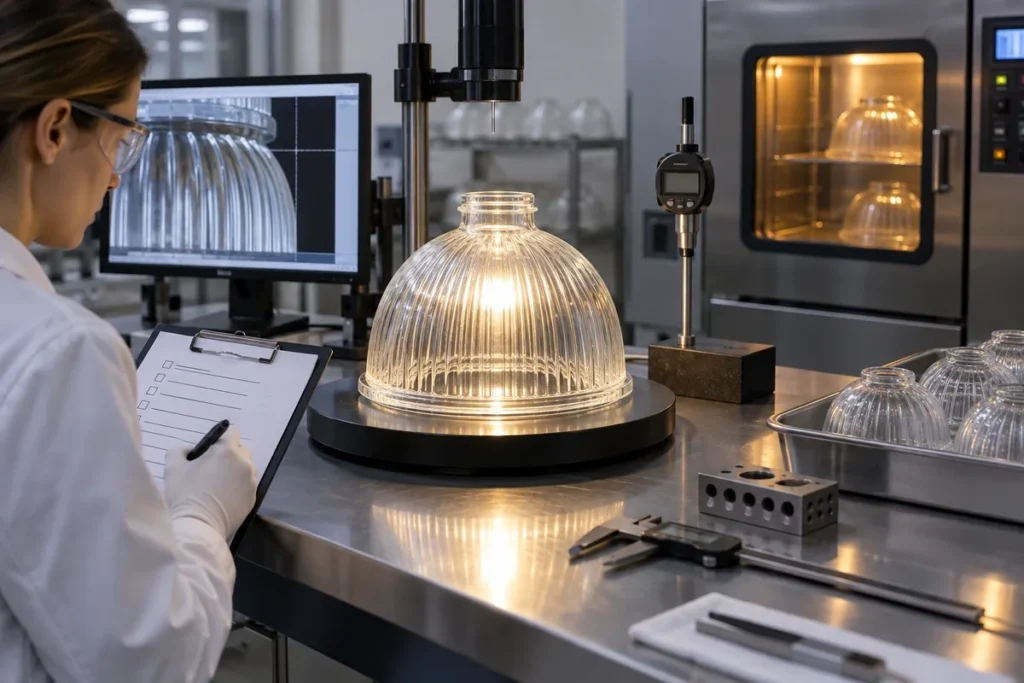
Secondary glass processing converts a formed or cut blank into an assembly-ready component. Grinding controls edges and fit, drilling creates mounting or flow features, sandblasting changes diffusion or appearance, coating modifies spectral or decorative behavior, and strengthening changes the surface stress state. These operations cannot be arranged arbitrarily; the drawing and process plan must define their sequence and protected zones.
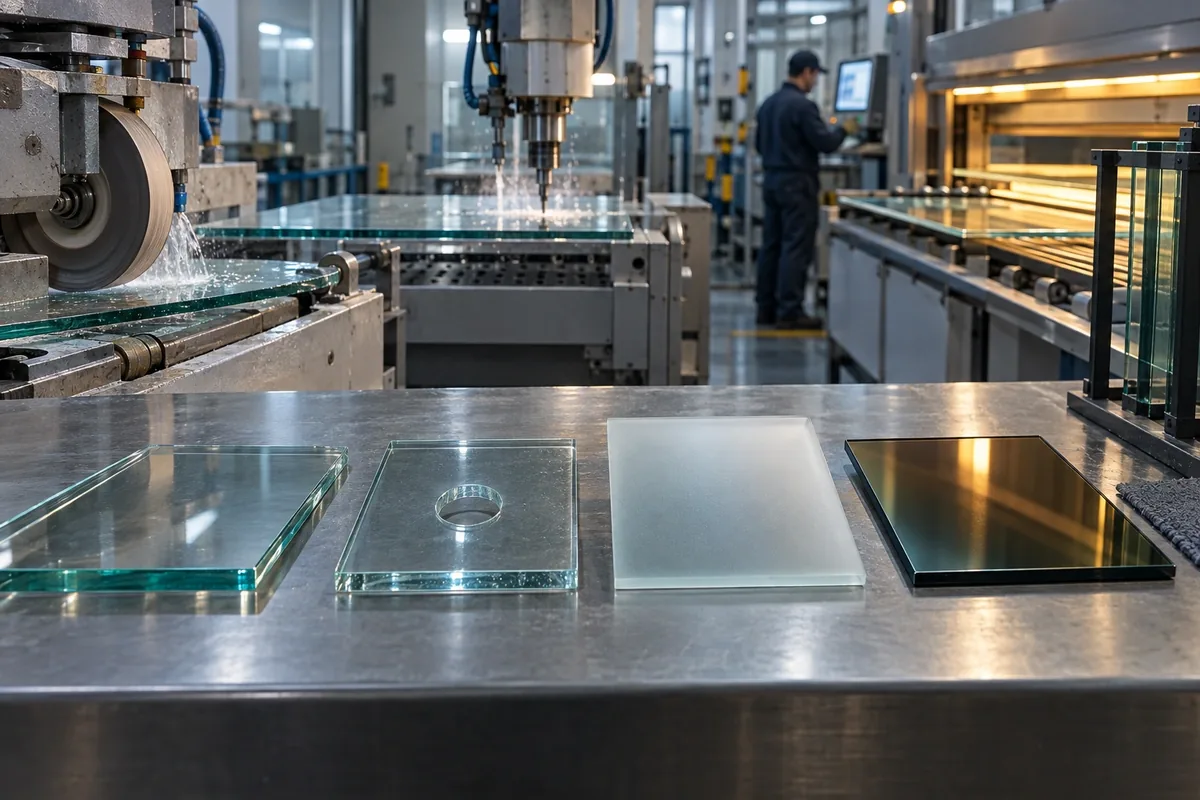
Key Takeaways
- Complete geometry-changing operations before tempering or final coating whenever the selected route requires it.
- Dimension holes, edges and masked zones from functional datums, not from an uncontrolled cut edge.
- Specify finish and coating by measurable result and approved reference, not by color name alone.
- Confirm each operation against glass composition, thickness and three-dimensional geometry.
What Does Each Secondary Operation Control?
Grinding removes sharp edges, improves fit and prepares sealing or cosmetic surfaces. Drilling and machining create holes, slots or local geometry but can introduce edge damage if the route is unsuitable. Sandblasting roughens selected surfaces to diffuse light or create a matte appearance. Coating can reduce reflection, filter wavelengths, add color or provide a decorative finish.
Thermal tempering and chemical strengthening are different processes with different suitability ranges. Neither should be specified as a generic checkbox. Material, thickness, shape and required performance determine whether a stable route exists.
Choose a Feasible Process Sequence
| Operation | Usually planned before | Key drawing controls |
|---|---|---|
| Cutting / rough shaping | Fine finishing, strengthening and coating | Blank orientation, allowance and datum strategy |
| Edge grinding / polishing | Strengthening and final coating | Edge profile, chips, flatness and sealing band |
| Drilling / slotting | Thermal tempering and final coating | Diameter, position, edge distance and chamfer |
| Sandblasting / frosting | Final cleaning and some coatings | Surface side, mask boundary, texture and haze target |
| Coating | Final handling and assembly | Spectral/color target, side, mask, adhesion and cosmetic limit |
Dimension Holes and Edges for Glass
Hole position and edge distance influence both assembly and strength. Avoid sharp inside corners; use radii and suitable chamfers. A hole that accepts a metal screw should include clearance and a compliant washer or sleeve so the fastener does not impose point load. Sealing edges need a finish matched to the gasket rather than a generic polished appearance.
For molded parts, establish whether features are formed in the mold or machined afterward. A molded opening may be economical but less precise; a machined feature adds cost and handling but can support a tighter functional requirement.
Specify Frosting and Coating Without Ambiguity
State which surface is treated and supply a mask drawing. For frosting, define transmission/haze or an approved illuminated sample. For coatings, provide wavelength range, angle of incidence, target reflection/transmission, color tolerance, durability and environmental tests. Decorative color viewed in reflection can differ from transmitted color.
Cleaning and packaging are part of the process. Residue, fingerprints and abrasion may become visible after coating. Define protective interleaving and whether the customer will remove any film before assembly.
Secondary Processing at China Lampoptics
China Lampoptics can evaluate physical tempering, chemical strengthening, coating, sandblasting, drilling and related finishing for suitable glass components. Availability is confirmed by drawing because not every operation fits every composition, wall thickness or molded shape.
Provide material, formed or blank condition, edge/hole drawing, treated surface, mask, optical target, strengthening requirement, cosmetic standard and annual volume. The response can then define a feasible operation sequence and the data still needed.
Watch: A Related Glass or Optics Process
This video focuses on tempering, one operation whose position in the process sequence is especially important because major cutting or drilling is normally completed first.
Related Products and Capabilities
Continue Reading
Discuss Your Secondary Glass Processing Project
Send your drawing, application conditions, quantity and the characteristics that matter most. China Lampoptics will review the information and identify the open technical items before quotation.
Contact China Lampoptics