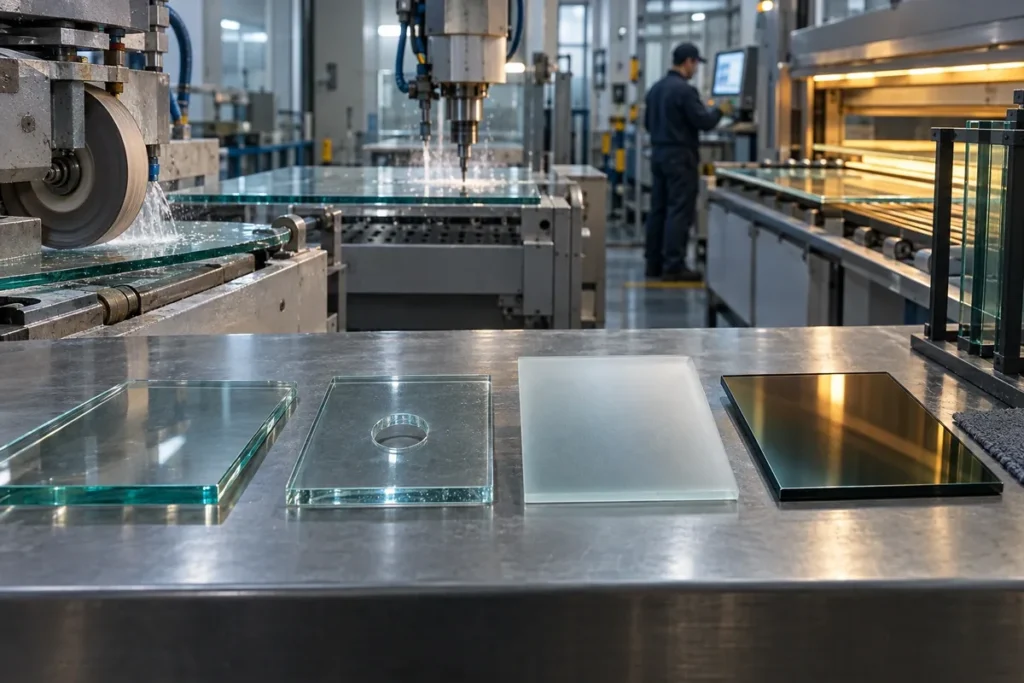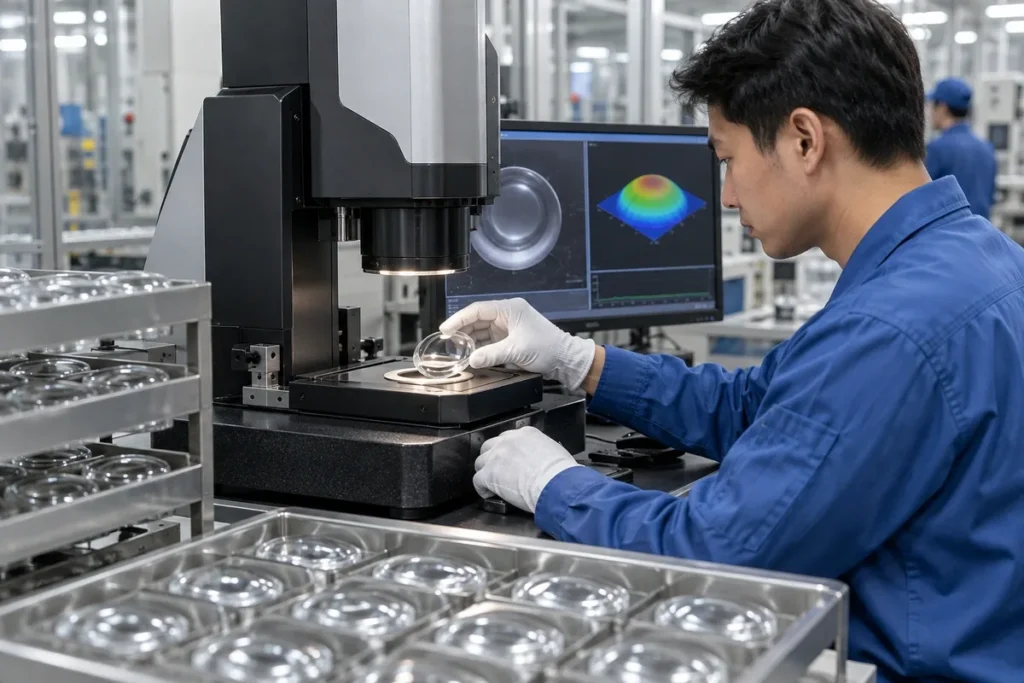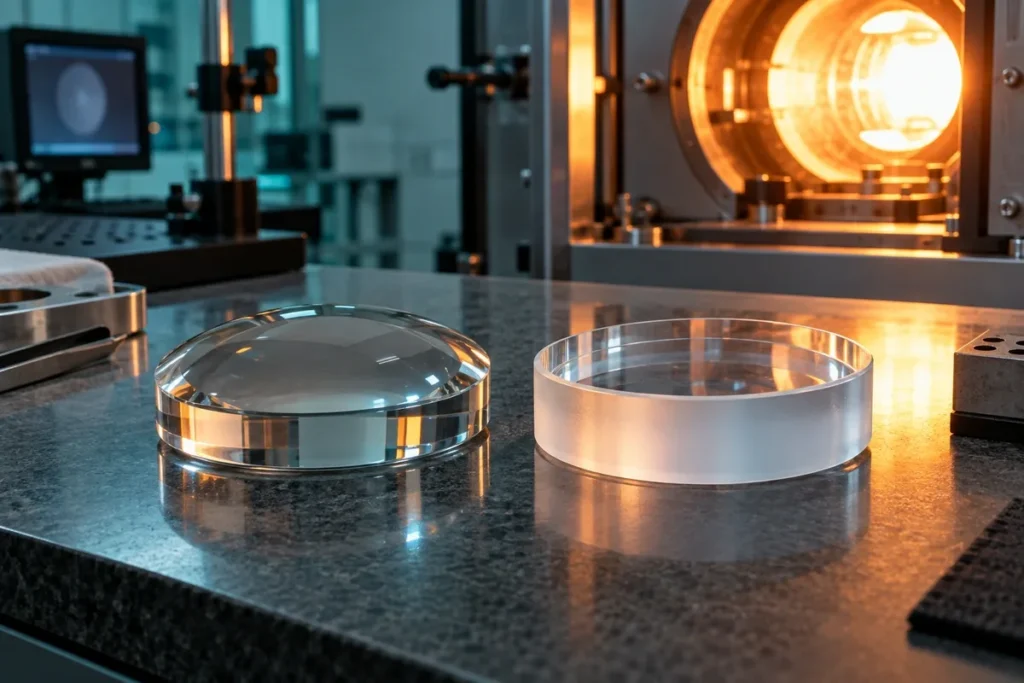
A glass lighting cover test plan should prove that the drawing, material and assembly work together under real service conditions. Dimensional inspection protects fit; visual inspection protects appearance; optical measurements protect output; thermal and mechanical tests address environmental loads. The plan becomes useful when every test has a defined specimen, fixture, condition, measurement and acceptance rule.
Key Takeaways
- Start with service risks and applicable product standards, then select tests that address them.
- Test the glass alone for process control and the assembled luminaire for system performance.
- Use the final holder, gasket and installation method for thermal, impact and sealing validation.
- Record drawing, material, mold/process revision and sample conditioning with every result.
Turn Requirements into a Verification Matrix
List each drawing or application requirement, its risk, verification method, sample quantity, acceptance limit and responsible party. A mounting diameter may be verified by a gauge, while light distribution requires an optical setup. Thermal shock may be a component screening test or an assembly-level qualification depending on the product.
Separate development tests from routine production inspection. Development may explore failure margins and compare designs; production tests should be stable, economical indicators that the approved process remains in control.
Core Test Groups for Lighting Glass
| Test group | Example characteristics | Best test level |
|---|---|---|
| Dimensional | Opening, height, diameter, flange, runout and wall distribution | Component and functional gauge |
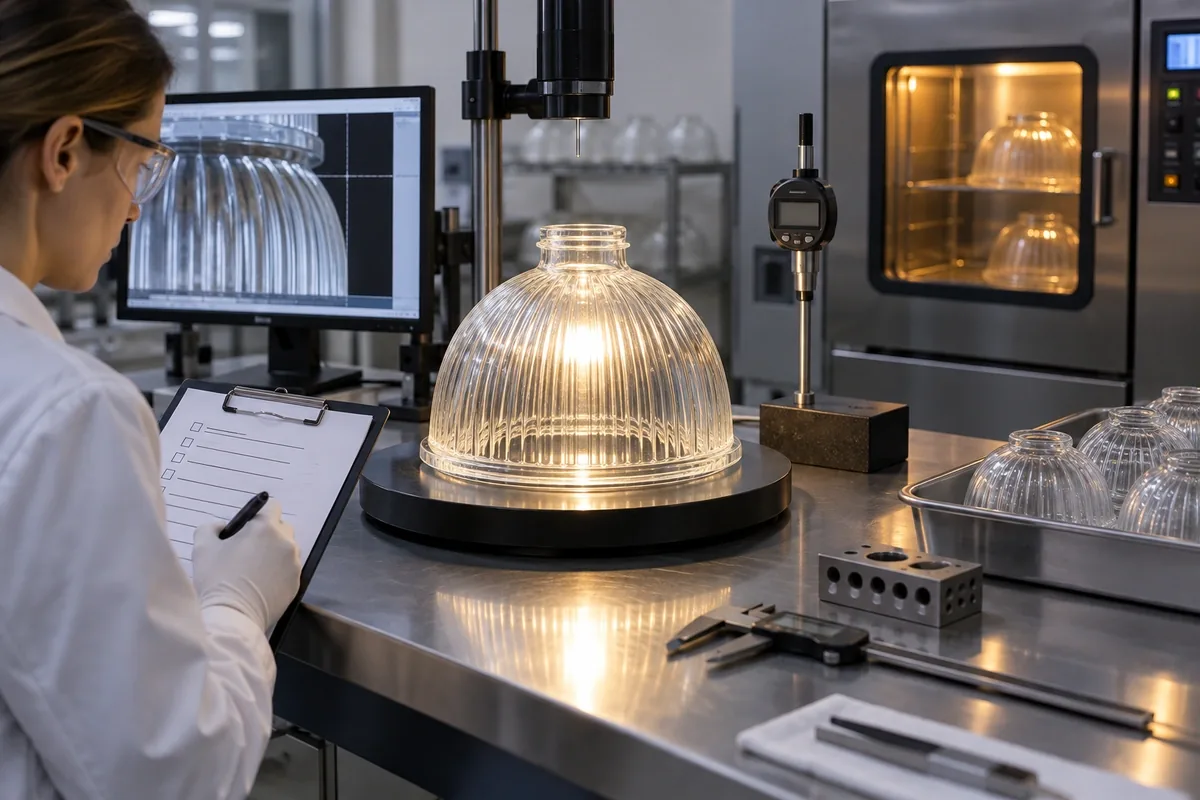
| Visual | Stones, bubbles, folds, scratches, finish and color | Component under controlled viewing conditions |
| Optical | Transmission, haze, beam, uniformity and source concealment | Component plus final light source |
| Thermal | Operating heat, cycling, gradients and cold-liquid exposure | Prefer complete mounted assembly |
| Mechanical/environmental | Impact, vibration, ingress, chemical exposure and retention | Complete enclosure or luminaire |
Control the Fixture and Sample Condition
A test fixture can create or hide failures. Support the glass at the same locations and with the same gasket compression as production. Define tightening sequence and torque or final retainer position. Condition samples for temperature and humidity where required, and record edge damage before testing.
For optical tests, control LED part/bin, current, temperature, distance, orientation and detector. For visual tests, control illumination, background, distance and viewing time. Repeatability should be demonstrated before limits are used for supplier acceptance.
Use Failures to Improve the Drawing and Process
A crack location, beam artifact or fit problem contains information. Document where it began, how the part was mounted and whether the result correlates with wall thickness, edge quality, mold condition or assembly. Avoid changing multiple variables before the cause is understood.
When a design passes, freeze the tested configuration. Link the report to drawing revision, glass, mold, secondary processing and assembly hardware. Future changes can then be assessed against a known baseline.
Planning Validation with China Lampoptics
China Lampoptics can support component dimensional, visual and agreed comparative checks and can prepare samples for customer or third-party validation. The applicable inspection equipment and external certification route depend on the product and standard.
Provide the verification matrix, fixture or mating part, service conditions, drawing, standard, sample quantity and reporting format. Safety, regulatory and complete-luminaire approval remain with the responsible manufacturer and qualified laboratory.
Watch: A Related Glass or Optics Process
The tempering video illustrates one controlled thermal process. Product validation should separately reproduce the heating, cooling and mounting conditions expected in the actual luminaire.
Related Products and Capabilities
Continue Reading
Discuss Your Glass Lighting Cover Test Plan Project
Send your drawing, application conditions, quantity and the characteristics that matter most. China Lampoptics will review the information and identify the open technical items before quotation.
Contact China Lampoptics