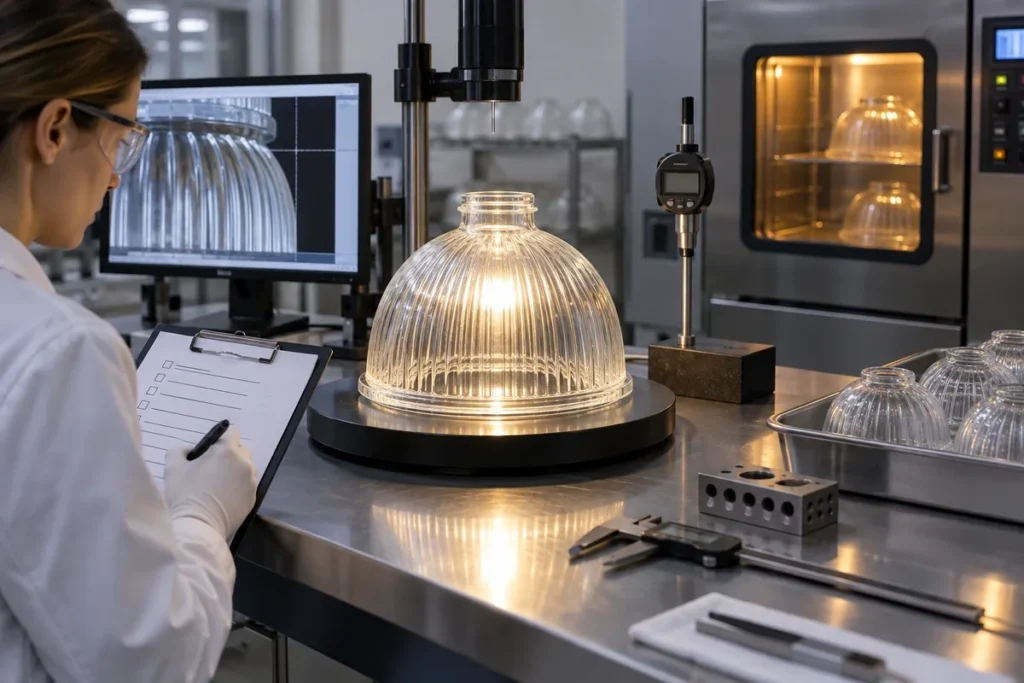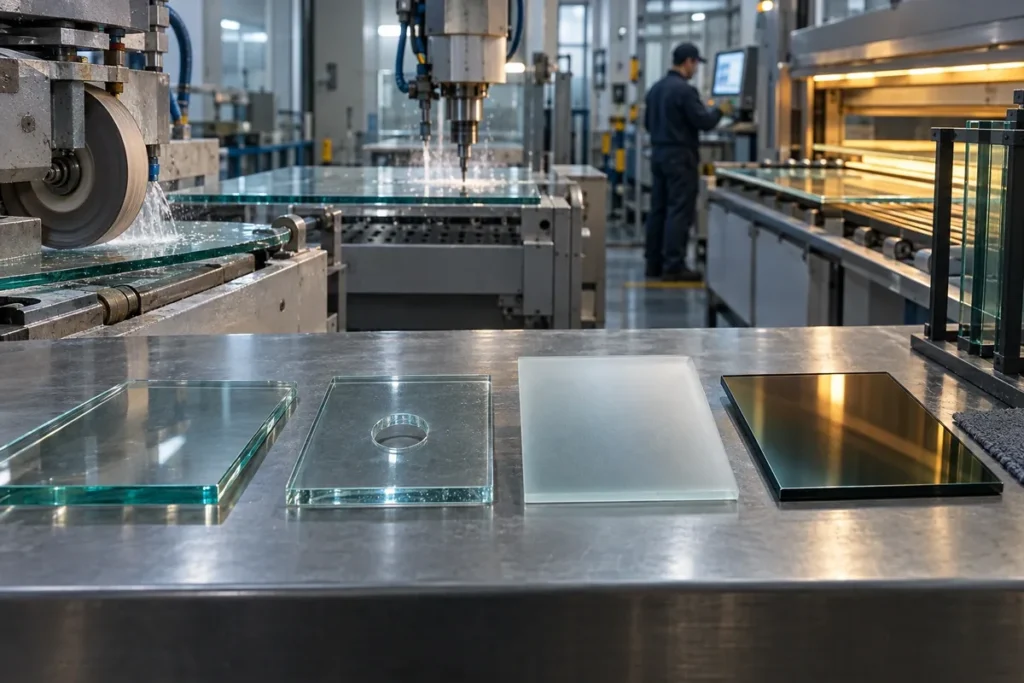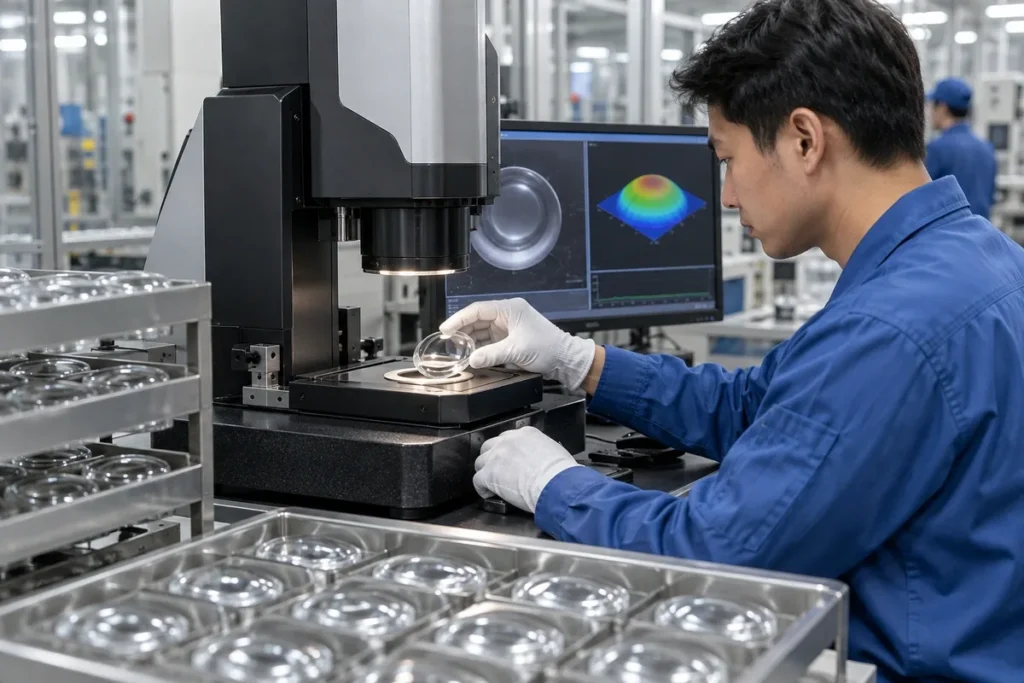
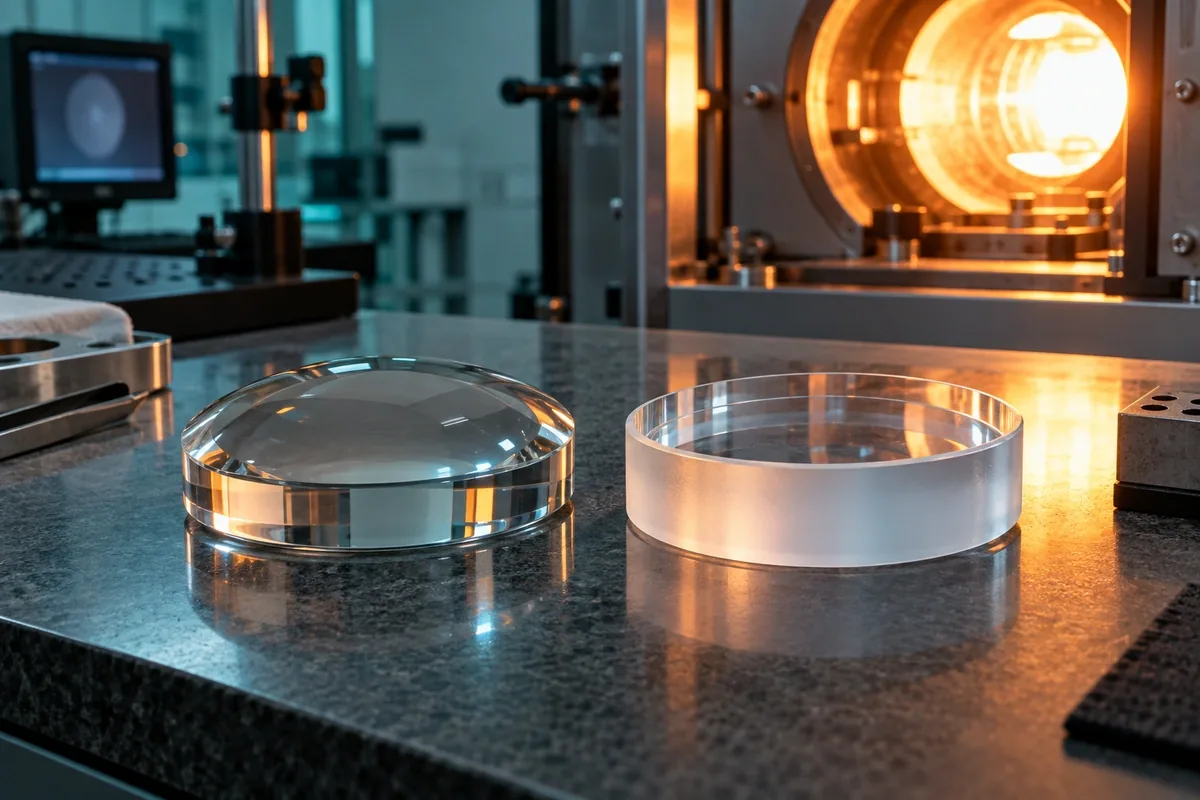
Optical glass vs fused silica is a specialized material decision for lenses that operate beyond general pressed-lighting requirements. Optical glass refers to many controlled compositions with different refractive indices, dispersion and transmission bands. Fused silica is a high-purity silica material valued for low thermal expansion, ultraviolet transmission options and thermal stability. It is not automatically the best choice when index, molding, availability or cost dominate.
Key Takeaways
- Begin with wavelength band, refractive index need, temperature cycle and optical power.
- Optical-glass families offer broader index and dispersion choices for compact lens design.
- Fused silica supports demanding thermal and UV applications but uses different processing economics.
- Do not replace one material with another without updating the optical prescription and validation.
What Does “Optical Glass” Mean in This Comparison?
Optical glass is not one chemistry. Crown, flint and specialty families are selected for refractive index, Abbe number, transmission, chemical behavior and process route. A designer can combine properties to control power and chromatic behavior. The exact commercial grade must be stated because a generic name does not define index or spectral limits.
Fused silica is mostly silicon dioxide in a non-crystalline structure, available in grades tailored to UV, visible or infrared performance. Purity, hydroxyl content and manufacturing route affect transmission. “Quartz glass” and “fused silica” are sometimes used loosely, so the required grade and spectral data should be explicit.
Optical Glass vs Fused Silica: Engineering Matrix
| Criterion | Optical glass families | Fused silica |
|---|---|---|
| Refractive choice | Wide range of index and dispersion | More limited index but stable, well-characterized behavior |
| Spectral options | Grade-dependent visible, UV or IR transmission | Strong UV/visible options with grade-dependent IR behavior |
| Thermal expansion | Varies by composition | Very low relative to common optical glasses |
| Manufacturing route | Grinding, polishing and selected precision/molded routes | Machining/polishing and specialized forming routes |
| Selection driver | Optical power, chromatic control and available process | Thermal stability, UV transmission or severe environment |
Define the Real High-Temperature and Spectral Duty
Record the temperature at the optic, gradient across it, heating and cooling rate and any contact with cold air or liquid. For UV or broad-spectrum lamps, define wavelengths and allowable absorption because absorbed energy can create additional heating. Coatings and cements may have lower temperature limits than the substrate.
Radiation environment, humidity and cleaning chemicals can also govern. A fused-silica substrate does not protect an unsuitable antireflection coating or mechanical mount.
Changing Material Changes the Lens
Refraction depends on index, so switching from an optical glass to fused silica changes focal length or beam distribution unless surface geometry is redesigned. Thermal behavior may improve while optical power decreases. Dispersion changes can alter chromatic effects in broad-spectrum systems.
Material tolerances, bubbles, inclusions, homogeneity and birefringence should match the application. Non-imaging lighting does not always require imaging-grade specifications, but high-power or UV systems may expose defects or absorption that general visible lighting would tolerate.
Material Review for Special Lighting Optics
China Lampoptics evaluates optical glass and fused-silica requirements for molded lenses and special high-temperature lighting components when the project falls within an appropriate manufacturing route. These materials complement the site's principal soda-lime, borosilicate and aluminosilicate directions rather than replacing them in every product.
Provide wavelength range, source power, temperature profile, index or focal requirement, geometry, surface quality, coating and volume. Grade availability and final process feasibility should be confirmed before the drawing is released.
Watch: A Related Glass or Optics Process
This Edmund Optics demonstration explains how refractive index affects ray direction, one of the main reasons optical material selection changes lens geometry.
Related Products and Capabilities
Continue Reading
Discuss Your Optical Glass Vs Fused Silica Project
Send your drawing, application conditions, quantity and the characteristics that matter most. China Lampoptics will review the information and identify the open technical items before quotation.
Contact China Lampoptics