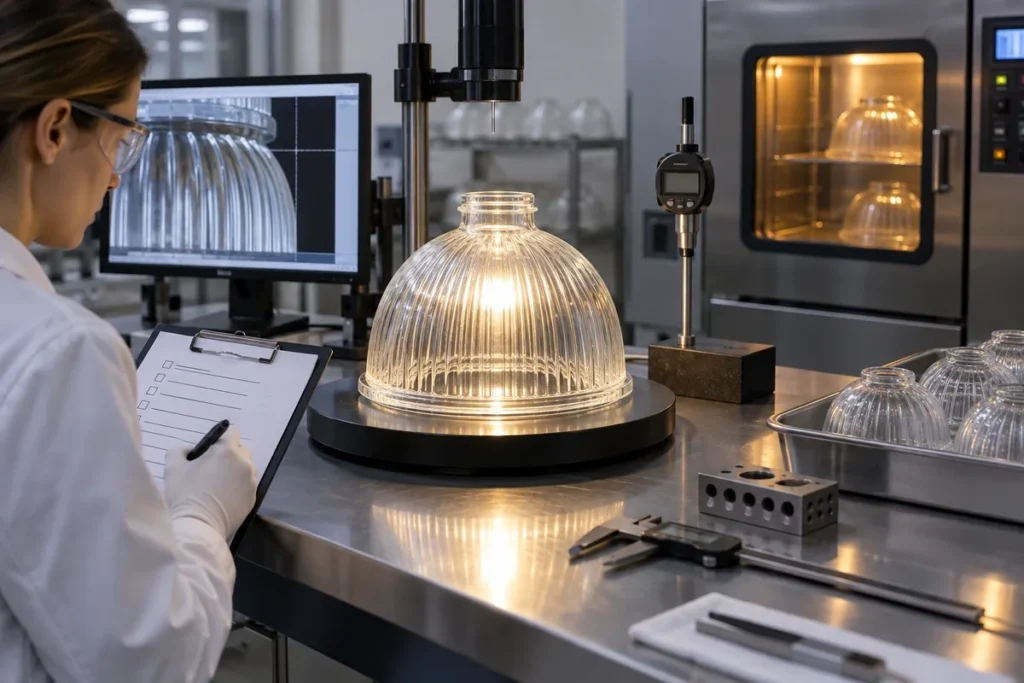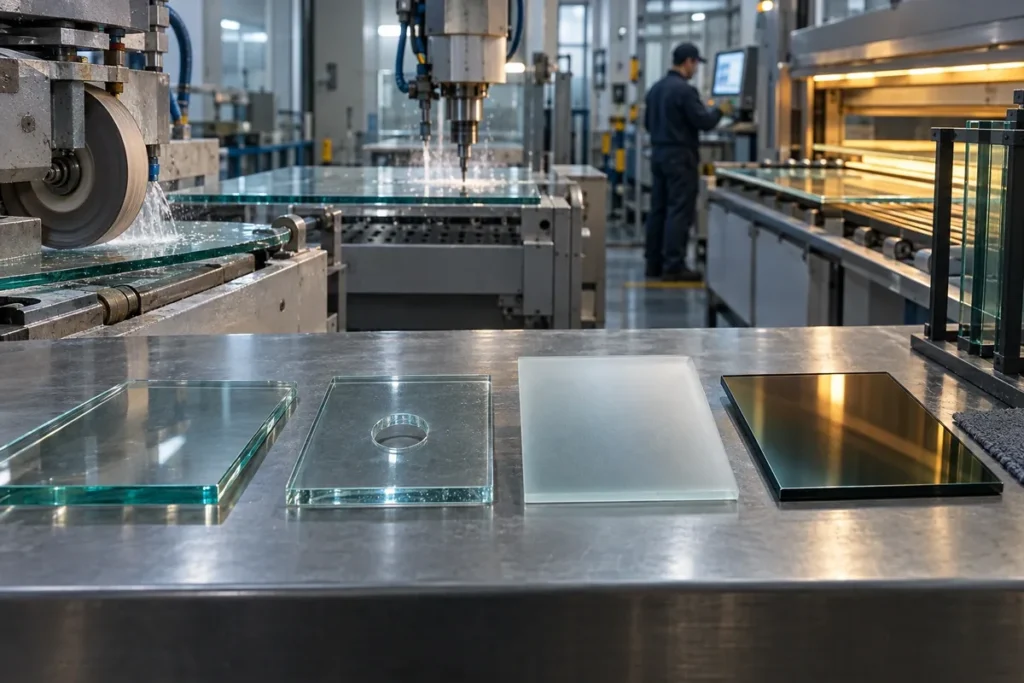
Conical glass lamp shade design connects a recognizable form with a controlled optical and mechanical function. Cone angle changes the projected luminous area, while top opening, bottom diameter and overall height determine source clearance and holder fit. Molded ribs or prisms can spread, redirect or soften the light. The design should therefore be evaluated as an illuminated assembly, not as an isolated decorative silhouette.
Key Takeaways
- Lock the mounting interface and light-source envelope before adjusting the cone profile.
- Use cone angle and source position together; either value alone is not a beam specification.
- Define rib direction, pitch and transition zones where they influence light or appearance.
- Separate critical fit dimensions from the flexible decorative envelope on the drawing.
Which Dimensions Control a Conical Shade?
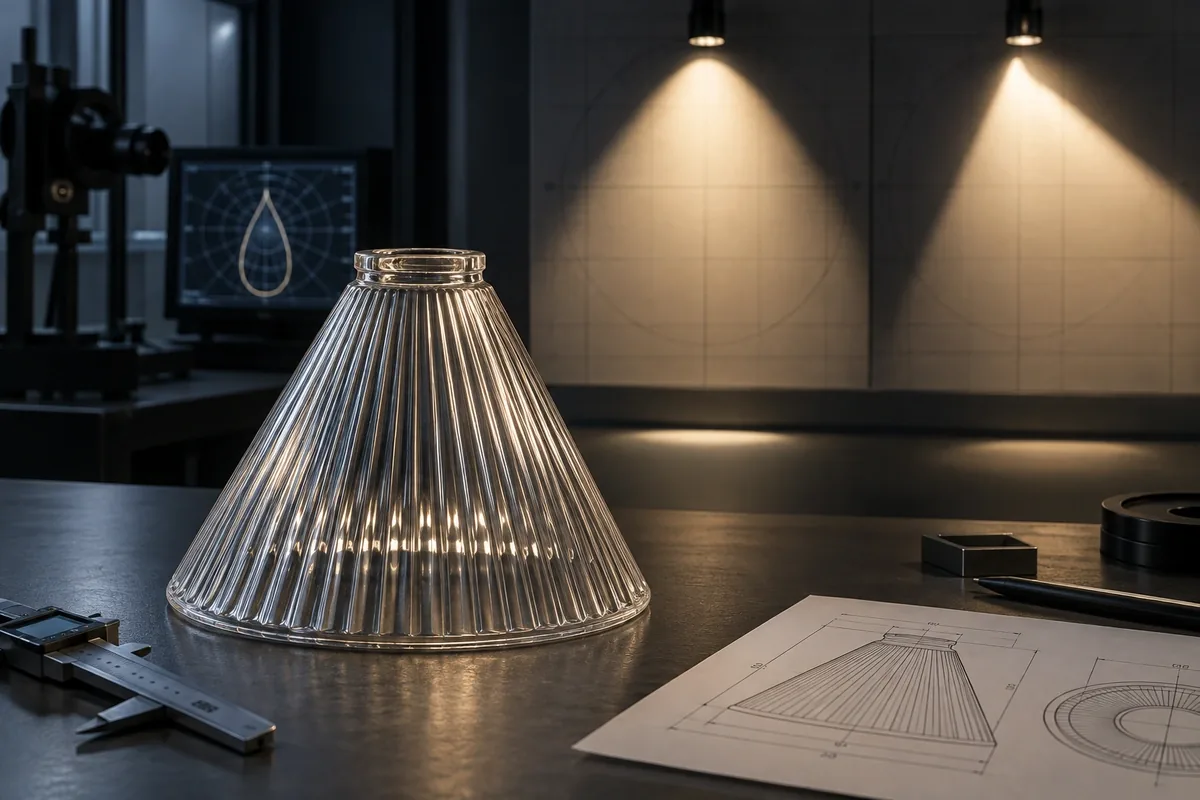
The top opening establishes access and usually defines the mounting region. Bottom outside diameter controls the visible scale and may limit fixture spacing. Overall height and cone angle locate the wall relative to the source. A skirt, flange or rolled rim adds retention and affects where the mold can part.
Dimension the functional axis, mounting face and source location in a common coordinate system. If the shade mates with an existing ring, supply that ring. Nominal wall thickness should be accompanied by an understanding that glass distribution varies around ribs, shoulders and opening transitions.
Relate Shape and Texture to Beam Intent
| Feature | Likely optical effect | Specification question |
|---|---|---|
| Steeper cone | Changes apparent luminous area and ray incidence | What is the required cutoff and viewing angle? |
| Vertical ribs | Redistribute rays across the rib direction and add sparkle | Inside or outside, and what pitch/depth? |
| Prismatic band | More deliberate redirection in a selected zone | Which beam region must it influence? |
| Opal body | Broad internal diffusion and source concealment | What transmission and uniformity are acceptable? |
| Frosted surface | Surface scatter and softer appearance | Which face and which areas remain clear? |
Avoid Hot Spots and Unwanted Pattern Imaging
An LED close to a ribbed wall can create repeating bright lines. A larger source-to-glass distance allows more mixing but increases fixture depth. An opal or frosted finish can reduce visible structure at the cost of some useful transmission. The correct combination depends on the LED pitch, reflector and observer position.
Use the real LED board during sampling. A single laboratory point source may exaggerate or hide effects compared with the final array. If a precise intensity distribution is required, define the photometric test plane and acceptance envelope.
Make the Cone Manufacturable in Pressed Glass
Continuous draft is naturally compatible with release, but decorative undercuts, abrupt flares and sharp rib valleys can create problems. Add feasible radii at the top shoulder and bottom rim. Discuss the parting line, trimming route and zones where tong or handling evidence may be accepted.
First samples should be checked for fit, overall profile, glass distribution, pattern replication and illuminated appearance. If dimensions drift with process conditions, a functional gauge at the opening can protect assembly while the body is controlled to an appropriate envelope.
Custom Conical Shade Support
China Lampoptics develops conical pressed glass shades from customer drawings and approved samples. Available clear, opal, colored, ribbed and secondary-finished routes are reviewed against geometry, quantity and application conditions.
Provide the holder, light-source position, target beam or appearance, material preference, finish sample, critical dimensions and volume. Early review makes it possible to adjust the cone, ribs and mounting transition before production tooling.
Watch: A Related Glass or Optics Process
This introductory optics video shows how surface angle redirects light. A conical shade is not an imaging lens, but the same refraction principle helps explain why wall angle and ribs change its beam.
Related Products and Capabilities
Continue Reading
Discuss Your Conical Glass Lamp Shade Design Project
Send your drawing, application conditions, quantity and the characteristics that matter most. China Lampoptics will review the information and identify the open technical items before quotation.
Contact China Lampoptics