Fresnel vs TIR glass lenses is not a contest between two interchangeable shapes. A Fresnel lens divides a refracting surface into concentric or segmented zones to reduce thickness. A TIR lens collects and redirects rays through a combination of refraction and total internal reflection. The right architecture depends on the source, beam target, available envelope, thermal environment and the features that can be molded reliably in glass.
Key Takeaways
- Fresnel profiles are useful when optical power is needed with reduced center thickness.
- TIR optics combine collection and redirection in a compact component but are sensitive to LED position.
- Glass supports hot environments, yet the complete luminaire temperature and stress state still govern suitability.
- Prototype measurements should evaluate efficiency, distribution, artifacts and assembly tolerance.
How Fresnel and TIR Lens Principles Differ
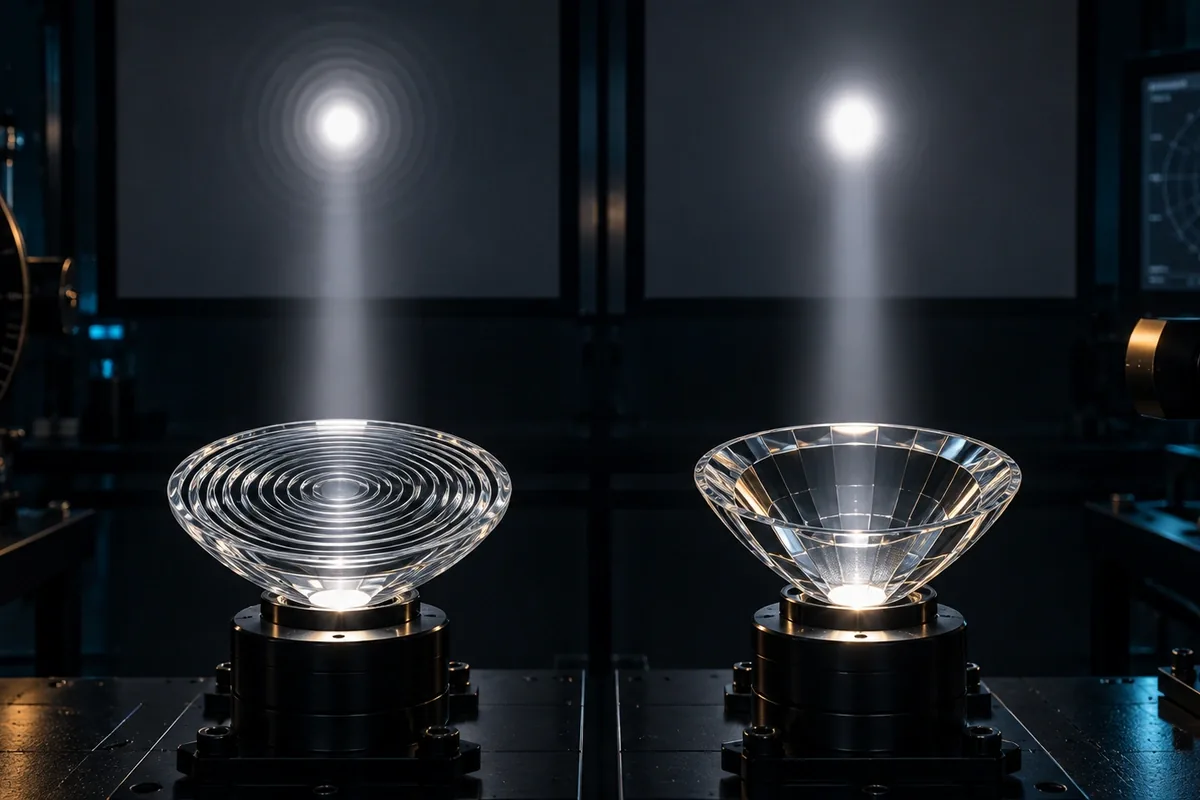
A Fresnel surface replaces a continuous curve with annular or linear zones. Each zone keeps the local slope needed to refract light, while material between zones is removed. In illumination, the grooves can collimate, focus or spread light, but groove pitch and source size influence visible structure and stray light.
A TIR optic normally accepts light through an entrance surface, redirects higher-angle rays at an internal boundary and shapes the outgoing beam at another surface. Its performance depends on maintaining the intended glass-air interface. Coatings, contamination or unintended optical contact can alter the internal-reflection condition.
Fresnel vs TIR Glass Lenses: Selection Table
| Criterion | Fresnel glass lens | TIR glass lens |
|---|---|---|
| Primary concept | Zoned refraction with reduced bulk | Refraction plus internal reflection for collection and redirection |
| Typical form | Relatively thin plate or shallow molded optic | Deeper rotational or freeform body around the source |
| Source sensitivity | Depends on focal relationship and source extent | Often highly sensitive to source height and centering |
| Potential artifact | Groove imaging, scatter or ring structure | Color separation, center artifacts or spill when misaligned |
| Mechanical question | Groove protection, orientation and flatness | Mounting around LED, air interface and thermal clearance |
What Changes in High-Temperature Lighting?
At elevated temperature, refractive index, dimensions and source output may shift. More importantly, the lens can see gradients created by a hot source, a cooler housing and intermittent airflow. Glass offers thermal and environmental advantages over many polymers, but material family, molded thickness, edge condition and mounting stress must be considered together.
Specify the temperature measured at the lens, not just the driver or heat sink. Include start-up and cool-down cycles and any cleaning or outdoor exposure. The holder should locate the optic without creating a rigid clamp that prevents expansion.
Manufacturing Features That Affect Optical Performance
Fine Fresnel grooves require appropriate draft, radii and mold replication. TIR surfaces need stable form and a clean interface. For both types, parting lines and ejector or handling regions should be kept away from critical optical zones. Center thickness, groove apex condition, entrance curvature and the relationship between molded and mounting datums should be measurable.
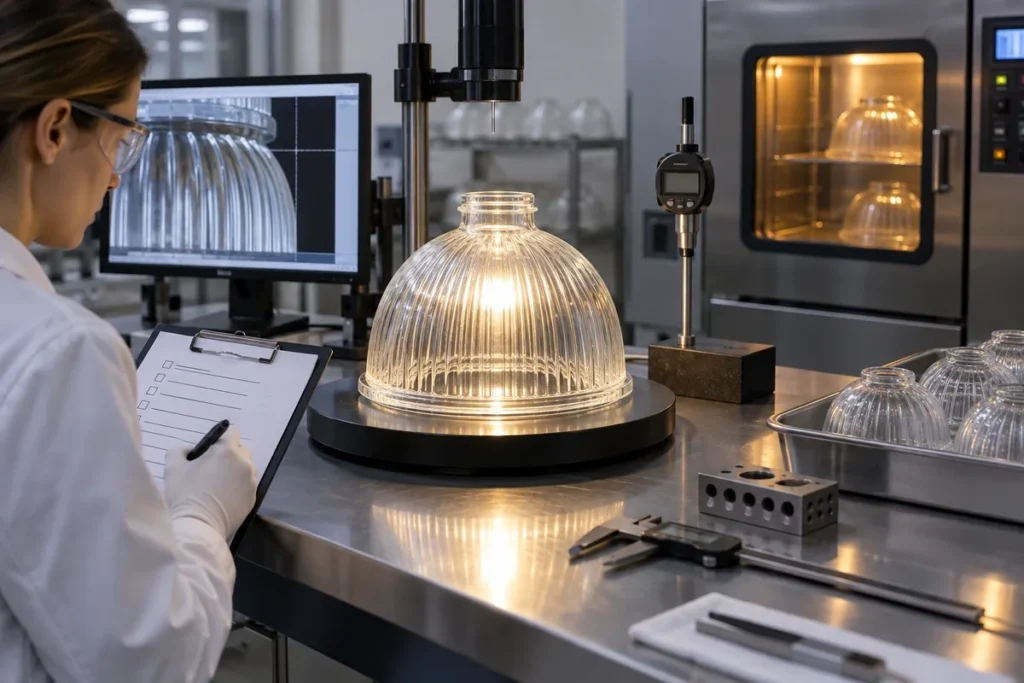
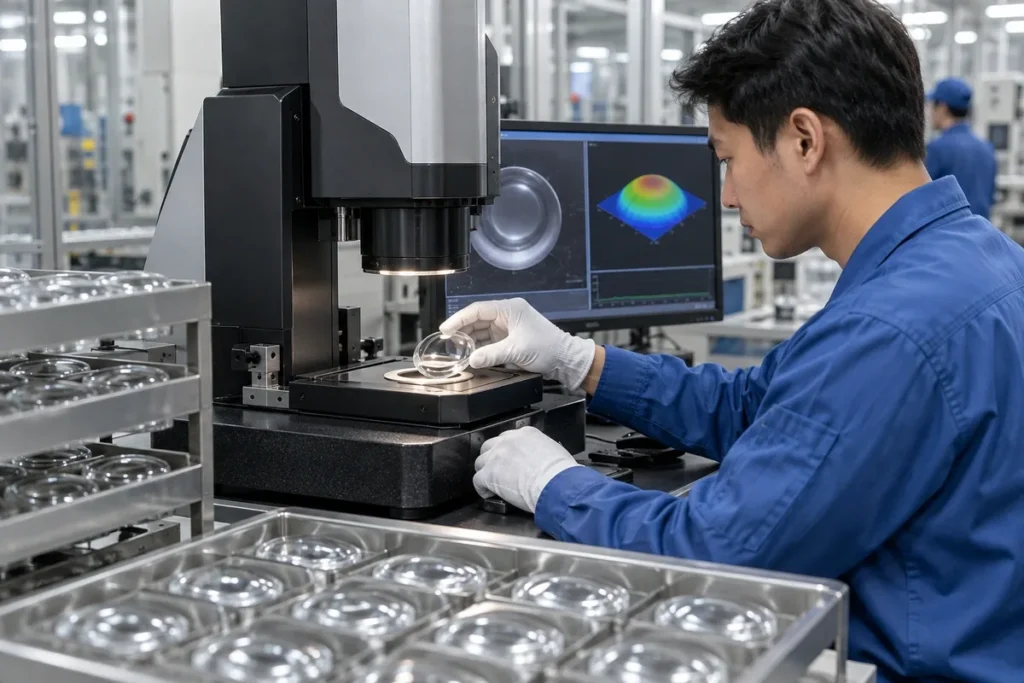
Performance inspection may combine dimensional checks with a comparative beam test. A surface can look cosmetically acceptable yet produce an unwanted ring; another may carry minor visual forming evidence without affecting the specified distribution. Acceptance limits should be tied to function.
Selecting a Custom Glass Beam-Control Optic
China Lampoptics reviews Fresnel and TIR glass lens projects against the source package, target distribution, material, forming geometry and assembly envelope. Existing samples can be measured and used as references, while new designs benefit from optical files and a clearly defined photometric target.
Send the LED data, lens position, allowable dimensions, operating temperatures, expected quantity and preferred validation method. The result may be a Fresnel profile, a TIR architecture, a hybrid molded lens or a different solution; the beam requirement should lead the geometry.
Watch: A Related Glass or Optics Process
This visual explanation by Nils Berglund shows how a Fresnel profile preserves refracting zones while reducing the bulk of a conventional lens.
Related Products and Capabilities
Continue Reading
Discuss Your Fresnel Vs Tir Glass Lenses Project
Send your drawing, application conditions, quantity and the characteristics that matter most. China Lampoptics will review the information and identify the open technical items before quotation.
Contact China Lampoptics