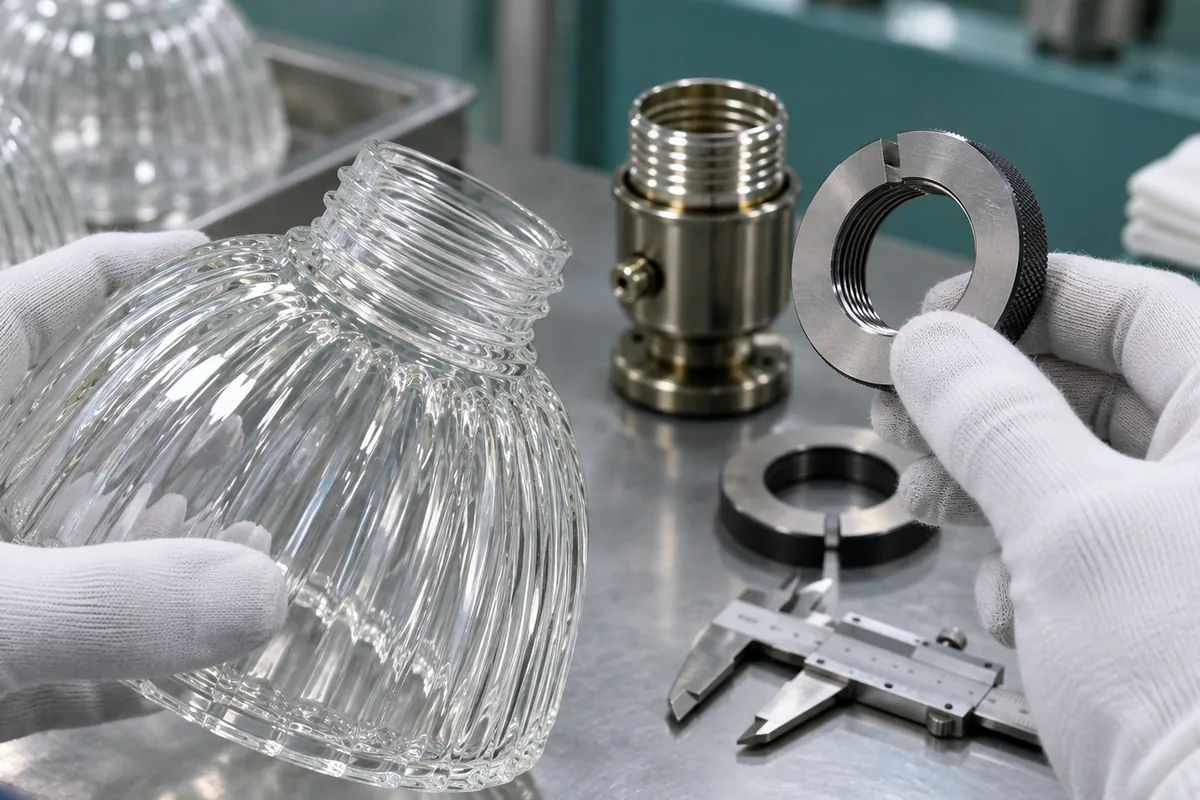
Threaded glass lamp shades need a mounting system, not an isolated thread callout. The glass neck, lead-in, pitch, usable engagement, seating face, holder clearance, gasket and assembly torque must work together. Because hot glass forming does not behave like cutting a metal thread, the interface should be specified around functional fit and safe load distribution rather than a machining-style expectation.
Key Takeaways
- Provide the mating holder or its controlled drawing with every threaded shade inquiry.
- Define seating and retention so the thread does not carry unintended bending or point loads.
- Use practical clearance and a functional gauge that reflects real assembly conditions.
- Protect the neck transition with generous radii and avoid over-tightening in the luminaire.
What Must Be Defined Beyond Thread Diameter?
A useful drawing identifies the thread form or approved reference profile, pitch, major and minor envelope, start location, engagement length, lead-in and stop condition. It also dimensions the opening and the seating surface relative to the shade axis. If the holder tightens against a gasket or shoulder, specify the compressed position and allowable contact band.
Mold parting and glass flow can influence the neck. The designer should agree where a seam is acceptable and how flash will be controlled. A thread that passes a loose diameter check may still bind if ovality, runout or the start geometry is wrong, which is why mating fit matters.
Select the Right Retention Concept
| Retention concept | Advantage | Design caution |
|---|---|---|
| Direct threaded holder | Compact assembly and easy replacement | Control torque, clearance, lead-in and thermal expansion |
| Threaded retaining ring | Separates holder position from shade rotation | Provide broad contact and prevent edge loading |
| Set screws at neck | Simple hardware and adjustable position | Use compliant tips and multiple balanced contacts |
| Flange with gasket | Distributes load and may improve sealing | Control flange flatness, gasket compression and clamp force |
| Spring clip | Fast service access | Avoid concentrated force and uncontrolled vibration wear |
Account for Glass Variation and Assembly Loads
Pressed glass dimensions reflect mold condition, glass temperature and cooling. The interface needs enough clearance to assemble through normal production variation while staying secure in service. The holder should not force an out-of-round neck into a rigid metal circle. A compliant gasket or distributed retaining surface can accommodate small variation and reduce stress concentration.
Torque values should be established by assembly testing with the actual holder, gasket and shade—not borrowed from a metal fastener table. Consider vibration, repeated relamping, thermal cycling and contamination. A positive stop can prevent an installer from continuously increasing torque.
Use Functional Gauges and Fit Testing
A go/no-go gauge or master mating ring can control a complex molded thread more effectively than trying to measure every local feature. The gauge must represent the approved holder clearance and engagement, and its calibration method should be documented. Dimensional checks remain useful for diagnosing drift, but the functional gauge answers the primary assembly question.
First-article testing should include repeated assembly, seating position, wobble, removal, gasket condition and visual examination of the neck. If the shade is sealed, add the intended ingress or pressure-related test at the luminaire level.
Developing Custom Threaded Lamp Glass
China Lampoptics can review threaded glass lamp shade drawings and physical mating parts for mold development and fit planning. The review examines the neck transition, thread release, parting location, seating surface and appropriate inspection method before tooling is finalized.
Send both components, the assembly sequence, gasket information, thermal conditions and required replacement behavior. This provides a more reliable basis than specifying only the opening diameter.
Watch: A Related Glass or Optics Process
This Corning video uses a different glass-forming process, but it helps explain why temperature, viscosity and controlled forming strongly influence final geometry—especially relevant to mounting features.
Related Products and Capabilities
Continue Reading
Discuss Your Threaded Glass Lamp Shades Project
Send your drawing, application conditions, quantity and the characteristics that matter most. China Lampoptics will review the information and identify the open technical items before quotation.
Contact China Lampoptics