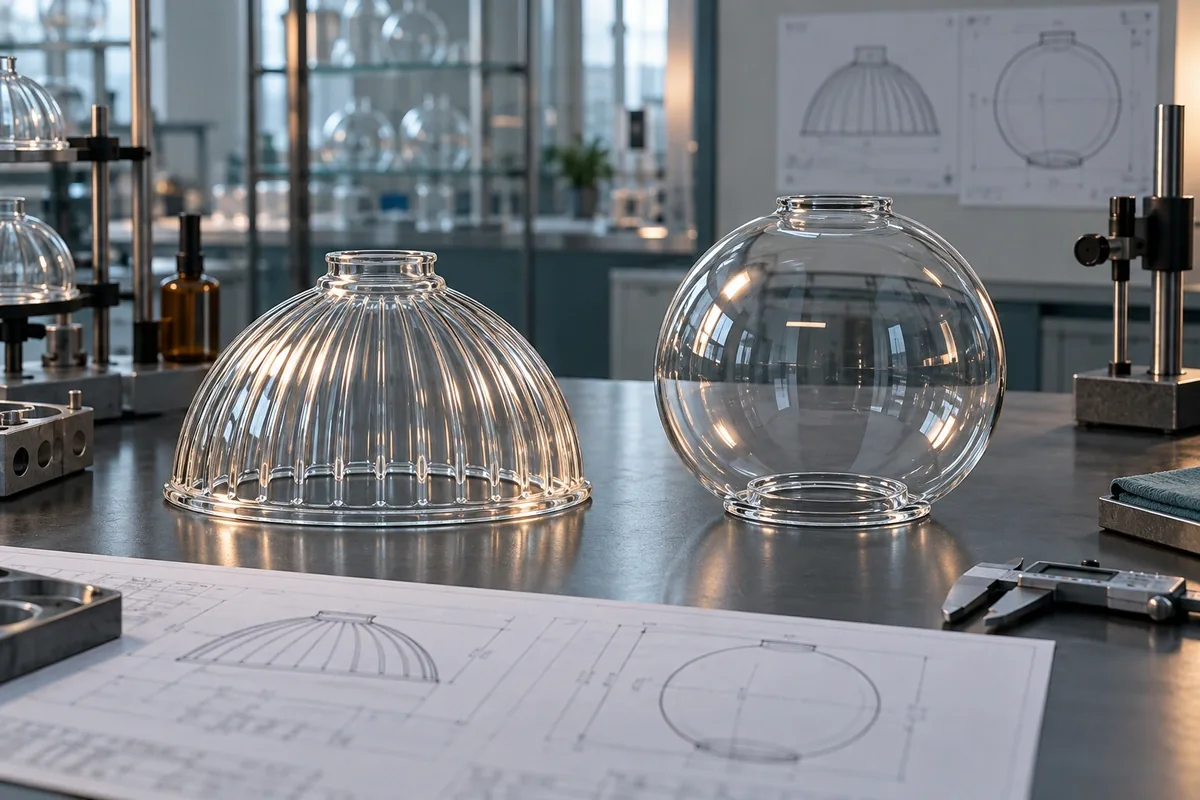
Glass dome vs globe lamp shades is primarily a system-design choice. A dome covers one side of a source and usually leaves a broad mounting plane. A globe wraps farther around the source, producing a more complete luminous volume but also introducing deeper forming, tighter assembly access and a more demanding opening transition. The correct profile follows the light distribution, luminaire envelope, mounting method and cleaning or relamping needs.
Key Takeaways
- Choose a dome for directional coverage and a globe when the design needs a fuller luminous volume.
- Dimension the opening, seating surface and source position before refining decorative curvature.
- Evaluate wall thickness, draft and neck transition because deeper globes are more demanding to press.
- Judge samples illuminated and installed; a loose bench sample does not show holder shadow or access limits.
How Do Dome and Globe Profiles Change the Light?
A shallow dome mainly intercepts rays travelling toward one hemisphere. Depending on its molded texture, it can diffuse downward light, protect a reflector or form the visible front of an industrial luminaire. A globe surrounds more of the source and can distribute brightness over a larger apparent surface. That may improve visual softness, but the holder, neck and internal hardware can cast shadows through the upper portion.
Source position is decisive. Moving an LED board or filament a small distance relative to a ribbed dome changes the illuminated pattern. In a globe, the same movement can shift brightness around the full circumference. Specify viewing directions, target distribution and acceptable source visibility instead of choosing shape from an unlit catalog photograph.
Glass Dome vs Globe Lamp Shades: Practical Comparison
| Design factor | Dome shade | Globe shade |
|---|---|---|
| Optical coverage | One primary hemisphere or direction | Broad wraparound luminous surface |
| Mounting | Flange, rim, neck or retaining ring | Neck opening, threaded finish or collar |
| Forming depth | Often shallower and easier to access | Deeper body with greater glass-flow challenge |
| Service access | May provide broad removal path | Opening can constrain lamp, board or tool access |
| Visual character | Architectural, industrial or reflector-like | Classic spherical, decorative or omnidirectional |
Design the Opening and Neck Before the Body
The interface determines whether the shade assembles reliably. Identify the seating face, gasket, retaining ring, screws or thread, and relate them to a controlled datum. The opening must clear the light engine and allow replacement if required. For globes, the neck-to-body transition needs generous radii so glass can flow and stress is not concentrated at a thin corner.
Provide the mating holder drawing and define acceptable wobble, engagement and installed height. Do not apply metal-machining tolerances to a molded glass neck without a functional need. A master holder or go/no-go gauge often controls fit more directly.
Account for Molding, Parting and Appearance
Dome molds may place a parting line near the flange or widest diameter. Globe tooling must release a more enclosed shape and may require careful parting strategy or inserts. Discuss where seams, shear marks and minor forming evidence may appear, then protect the primary viewing zones.
Ribs, prisms and stipple can hide the light source or create decoration. Their depth and direction must remain compatible with mold release. Opal body glass and surface frosting offer different diffusion mechanisms, so finish should be reviewed with the shape and wall profile.
Custom Dome and Globe Development at China Lampoptics
China Lampoptics reviews custom dome and globe lamp glass from drawings or physical samples. The engineering review connects opening fit, body geometry, molded pattern, material, secondary finish and production inspection. It also identifies which dimensions can be held directly and which are better controlled by functional fit.
Send the 2D drawing, 3D file, holder or holder drawing, LED position, desired appearance, thermal conditions and annual quantity. If a current shade is being replaced, include photographs of the installed assembly and the reason for the change.
Watch: A Related Glass or Optics Process
This Corning production overview uses a different forming method, but it makes the dependence of glass shape on temperature, viscosity and controlled tooling easy to see.
Related Products and Capabilities
Continue Reading
Discuss Your Glass Dome Vs Globe Lamp Shades Project
Send your drawing, application conditions, quantity and the characteristics that matter most. China Lampoptics will review the information and identify the open technical items before quotation.
Contact China Lampoptics