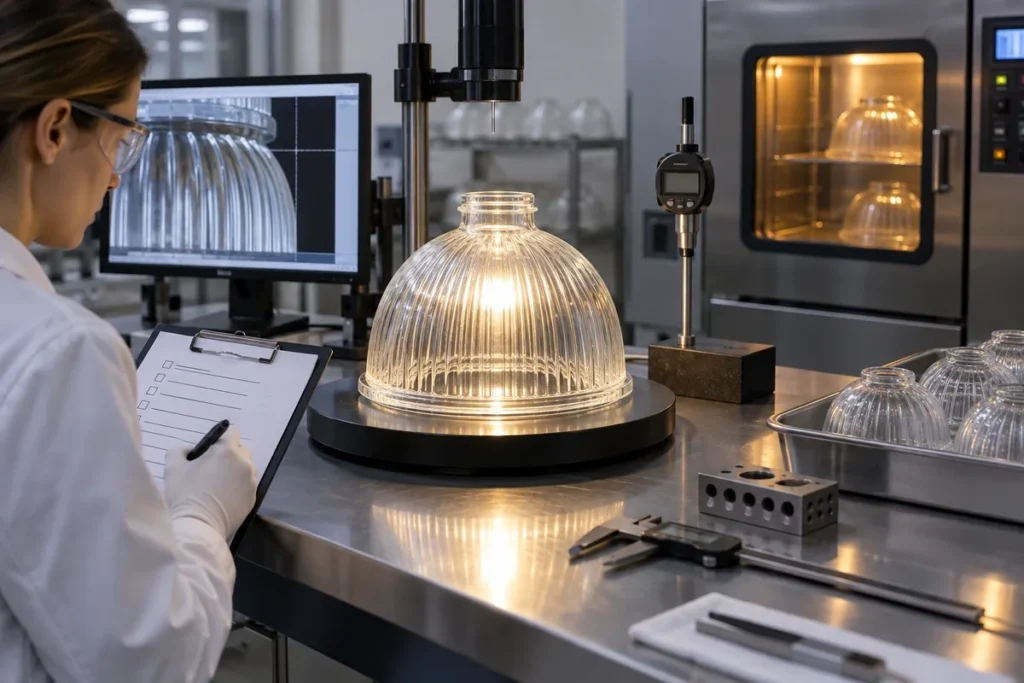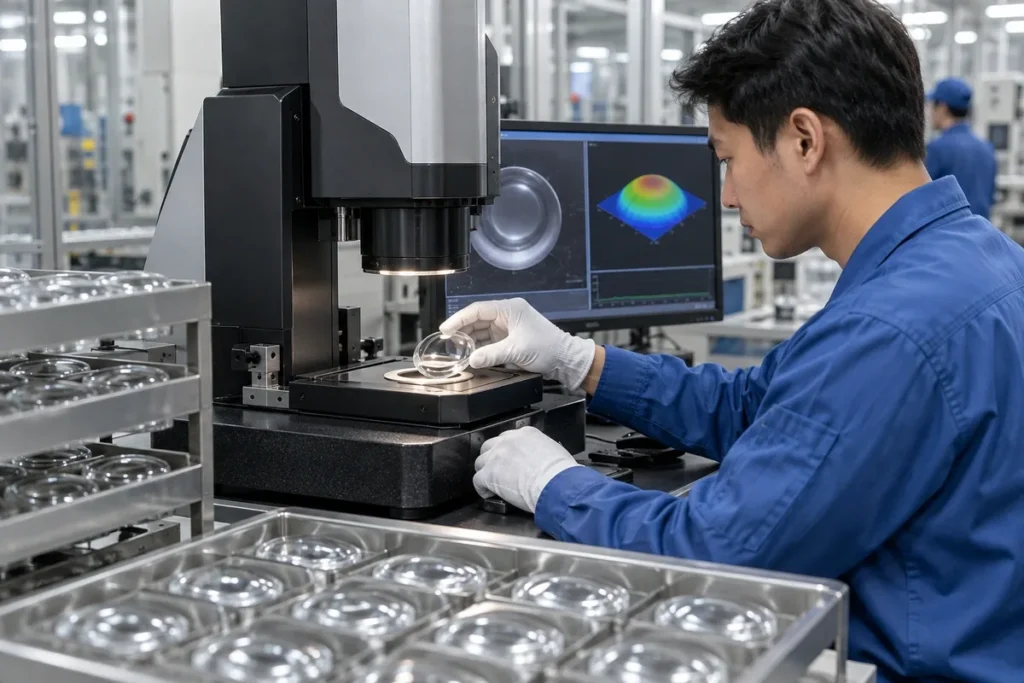
The borosilicate vs soda-lime glass decision is best made from service conditions and process compatibility, not from the assumption that the more heat-resistant material is always better. Soda-lime glass is economical and versatile for many indoor and commercial lighting components. Borosilicate becomes valuable when thermal shock, sustained heat or a low-expansion requirement creates a real engineering need.
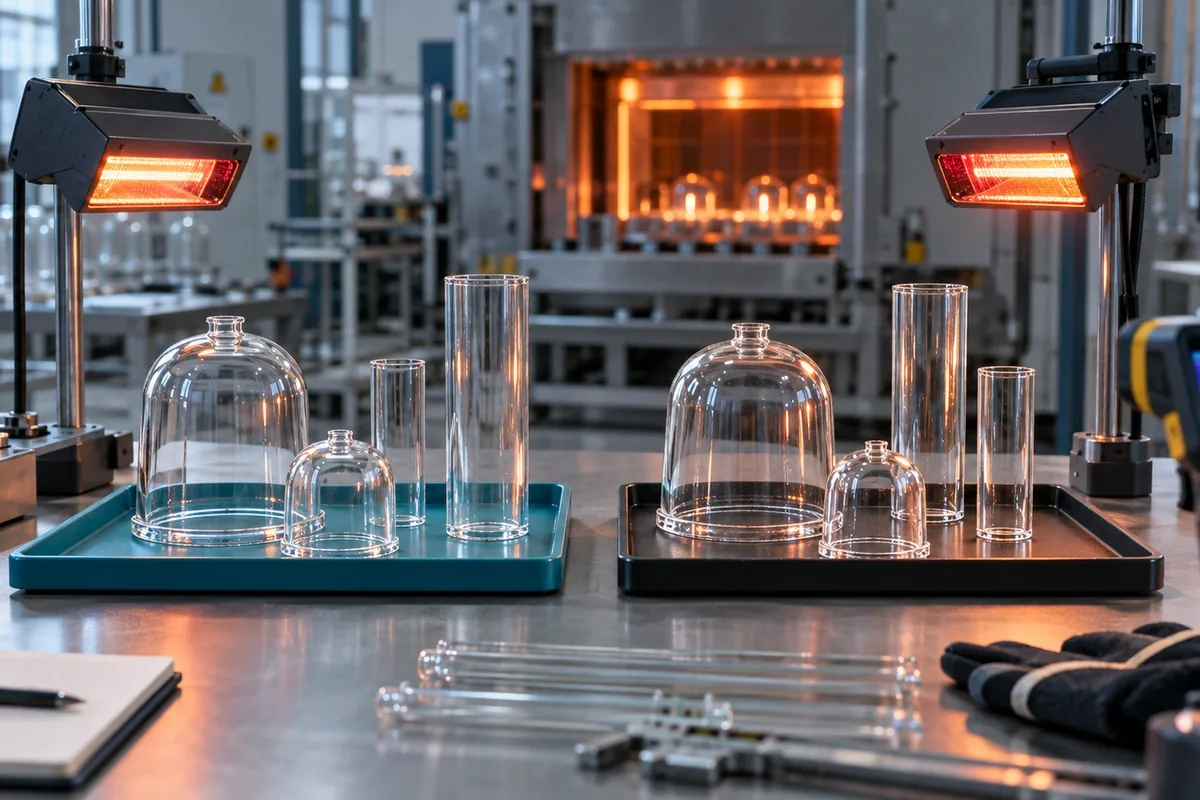
Key Takeaways
- Use the actual glass temperature and heating/cooling rate, not only ambient temperature.
- Soda-lime glass is often the practical baseline for pressed shades, covers and decorative parts.
- Borosilicate can improve thermal margin but changes forming, tooling and cost considerations.
- Geometry, thickness transitions and mounting stress can matter as much as material family.
What Is the Practical Difference Between the Two Glass Families?
Soda-lime glass is the common family behind a broad range of containers, architectural products and lighting parts. Its established supply chain and workable forming behavior make it a strong choice where the component sees moderate temperatures and controlled installation. Borosilicate contains boron oxide and is known for lower thermal expansion, which can reduce stress when temperature changes rapidly or unevenly.
That difference does not remove the need for good design. A thick boss next to a thin wall, a cold metal clamp or a sharp inside radius can concentrate stress in either material. Conversely, a well-designed soda-lime component may perform reliably in an application that never approaches severe thermal cycling.
Compare the Materials by Application Requirement
| Requirement | Soda-lime glass | Borosilicate glass |
|---|---|---|
| Typical lighting use | Decorative shades, general covers, many pressed components | Higher-heat covers, laboratory-style lighting and thermal-cycle-sensitive parts |
| Thermal expansion | Higher; design should manage gradients and restraint | Lower; useful where temperature change is a governing load |
| Forming and availability | Broadly established for mass-market pressed products | Requires a process route matched to its forming window |
| Appearance options | Clear, opal, colored, textured and secondary-finished options | Clear and engineered forms; available options depend on batch and process |
| Cost logic | Often lower for general requirements | Justified when thermal performance reduces application risk |
These are selection tendencies, not a substitute for a product specification. Chemical composition, heat treatment, part shape and supplier process all influence the finished component.
Define the Thermal Load Before Naming the Glass
Record the steady operating temperature at the glass, the start-up ramp, switch-off cooling rate, likely hot spots and the lowest expected ambient condition. Note whether rain, cleaning liquid or forced air can contact hot glass. Also identify nearby metal parts that restrict expansion. In compact LED luminaires, the glass may be cooler than legacy lamp covers, but localized heating and sealed enclosures still deserve review.
If the part is a lens, transmission and refractive behavior may narrow the material range. If it is a safety cover, edge condition, thickness, mounting and strengthening may dominate. Material selection therefore belongs after the component's job has been defined.
How Forming and Secondary Processing Affect the Choice
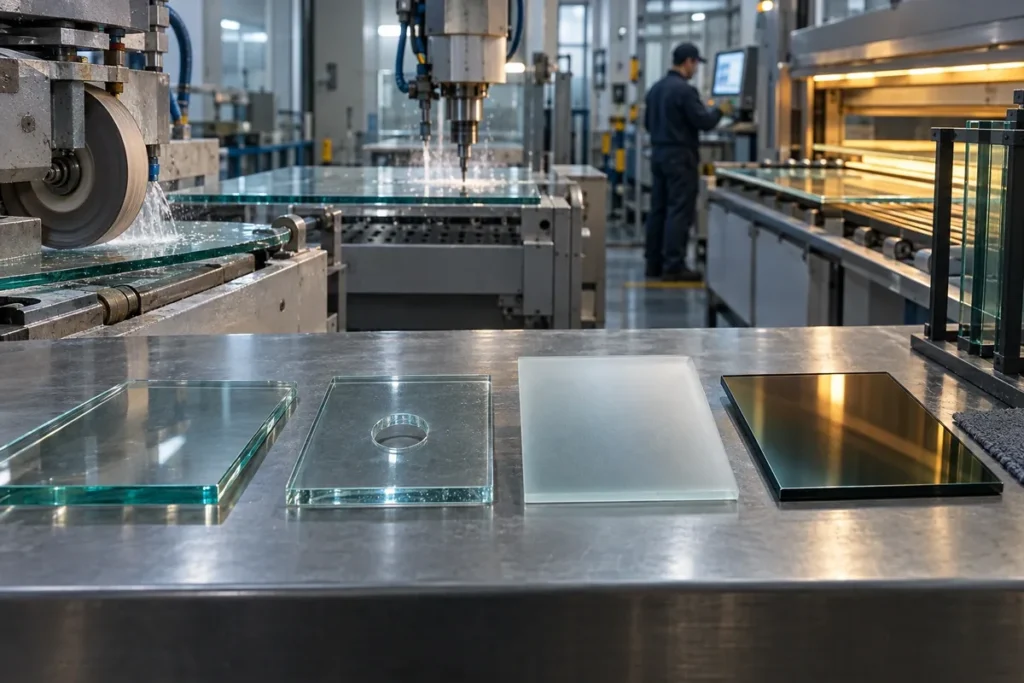
Pressed shapes need a material and mold cycle that can fill fine ribs or lens features without unacceptable folds, chill marks or distortion. Drilling, grinding, sandblasting, coating and strengthening add their own constraints. A finish that is routine on a flat panel may behave differently on a deeply molded shade.
Specify which surfaces require optical clarity and which may carry molded texture or secondary finishing. If tempering is requested, confirm that the part geometry, thickness and material can follow a stable strengthening route. If coating is required, define the spectral or decorative target and the zones that must remain uncoated.
Material Review at China Lampoptics
China Lampoptics evaluates soda-lime, borosilicate and other glass options in the context of the component drawing, forming route and secondary processing. For molded optical lenses or special high-temperature products, optical glass, aluminosilicate glass or fused silica may also enter the discussion, but they should not be substituted casually for a manufacturable pressed-glass design.
Provide the temperature profile, light source, enclosure drawing, mounting method, required finish, quantity and any existing failure evidence. The result should be a traceable material choice tied to the application—not a generic promise that one glass is universally superior.
Watch: A Related Glass or Optics Process
Corning's forming overview illustrates how glass composition, viscosity and thermal control are connected. The specific forming method differs from molded lamp components, yet the material-process relationship is directly relevant to specification work.
Related Products and Capabilities
Continue Reading
Discuss Your Borosilicate Vs Soda-Lime Glass Project
Send your drawing, application conditions, quantity and the characteristics that matter most. China Lampoptics will review the information and identify the open technical items before quotation.
Contact China Lampoptics