Sight glass and gauge glass are often grouped together, yet they solve different observation tasks. A sight glass provides a window into equipment or a process. Gauge glass shows a liquid level and may use reflex prisms to improve contrast. Water meter glass protects a readable register while maintaining a sealing surface. Selection starts with the viewing function, media, pressure, temperature and housing—not with a catalog diameter.
Key Takeaways
- Define whether the operator must see presence, flow, level, color, bubbles, markings or a digital register.
- Provide pressure, temperature, media and cleaning conditions to guide glass and surface selection.
- Treat sealing faces, edges, holes and gasket contact as functional features.
- Pressure-retaining applications require system-level engineering and applicable-standard review.
How Do Sight, Gauge and Water Meter Glass Differ?
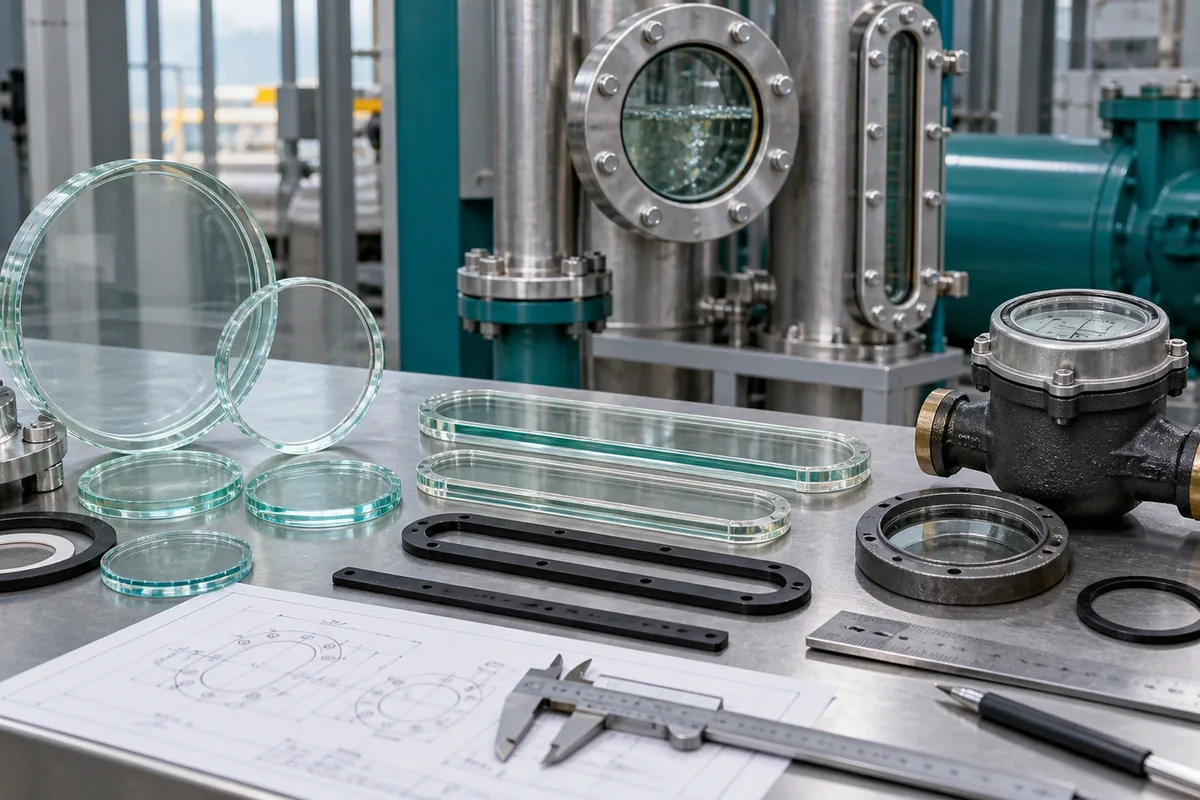
Round or oblong sight windows are used in tanks, pipelines, instruments and equipment covers. Their job may be simple presence inspection or detailed visual monitoring. Transparent gauge glass permits direct observation from opposite sides, while reflex gauge glass uses molded prisms so liquid and vapor regions appear with different brightness. Water meter glass is commonly a cover or window over the dial or register and must balance clarity with sealing and environmental durability.
Names vary by industry. The drawing and duty description are therefore more reliable than a product label. A “gauge glass” requested for a flat indicator cover may not need a prismatic level-gauge profile at all.
Compare the Three Technical Glass Functions
| Component | Primary viewing task | Common geometry focus | Critical inquiry data |
|---|---|---|---|
| Sight glass | Observe process condition through a wall | Round disc, oblong or custom window | Media, pressure, temperature, aperture and seal |
| Transparent gauge glass | Read liquid level directly | Elongated flat window with controlled faces | Gauge body, liquid, steam/vapor duty and gasket |
| Reflex gauge glass | Improve liquid/vapor contrast | Long glass with molded prism field | Prism profile, chamber design and viewing direction |
| Water meter glass | Protect and display a dial or register | Round window or molded cover | Seal diameter, readability, environment and impact |
Material and Surface Requirements
Glass selection depends on chemical exposure, temperature change, pressure duty, optical clarity and manufacturing route. Borosilicate may be relevant for thermal or chemical conditions, while soda-lime glass can be appropriate for general windows and meter covers. Application-specific glass may be required for demanding gauge service.
Viewing surfaces need agreed limits for scratches, stones, bubbles, distortion and residue. Reflex prisms are functional optical geometry, so pitch, angle and usable field matter. Sealing surfaces require flatness or form appropriate to the gasket. A polished appearance on the viewing face cannot compensate for a damaged gasket land.
Specify the Housing and Seal as Part of the System
Provide the recess, flange, clamp or threaded retaining geometry that supports the glass. Note gasket material, contact width, compression method and surface finish. Pressure loads create bending stress that depends on unsupported span and boundary condition; changing the housing can therefore change the required glass.
For pressure or hazardous service, the equipment designer remains responsible for the assembly calculation, standard selection and validation. Component dimensions should come from that system design. Avoid using an existing glass size in a new pressure class without engineering review.
Custom Technical Viewing Glass
China Lampoptics reviews sight glass, gauge glass and water meter glass projects for material, forming or machining route, surface requirements and inspection. Customer drawings, chamber samples and approved reference components help establish the functional geometry and sealing interface.
An effective inquiry includes use, media, pressure and temperature, dimensions and tolerances, glass preference, edge/face finish, quantity, testing requirement and responsibility for assembly certification. Unknown values should be marked for engineering resolution rather than guessed.
Watch: A Related Glass or Optics Process
This Corning production video demonstrates the level of thermal and process control used to create consistent glass. The component routes differ, but stable material and surface quality are equally important for technical viewing windows.
Related Products and Capabilities
Continue Reading
Discuss Your Sight Glass And Gauge Glass Project
Send your drawing, application conditions, quantity and the characteristics that matter most. China Lampoptics will review the information and identify the open technical items before quotation.
Contact China Lampoptics